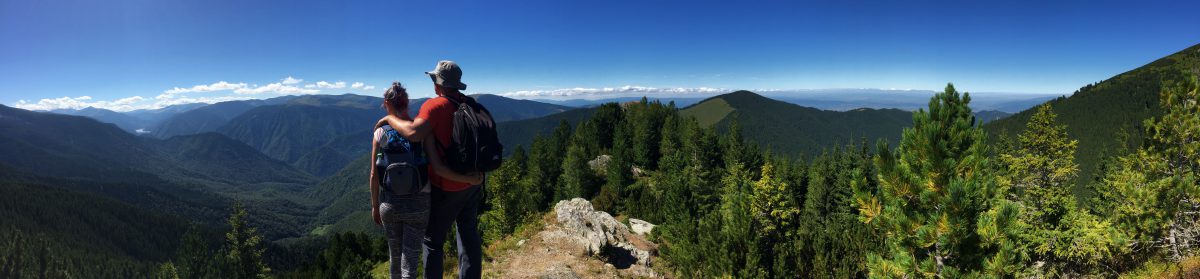
Russia, Mongolia, and Israel

Since you’ve last heard from us, we’ve traversed the Russian Altai Mountains, arrived in Mongolia, and skirted the Gobi desert for 1,600 kilometres to get to Ulaanbaatar, the capital of Mongolia. As you may well guess, we have some adventures to report.
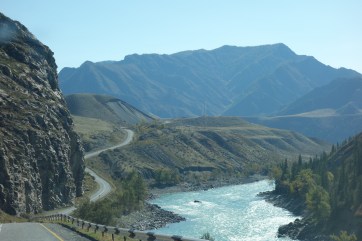
dsc06157
The Altai Mountains: there are mountains!

The Altai Mountains are spread over Kazakhstan, Mongolia, China, and Russia, making them an interesting cultural destination to say the least. Much of the mountains are only open to tourists who have a special border permit from the country of their choice. However, we avoided the necessity for a permit by staying on the Chusky Trakt, the famous road meandering south through the mountains from Barnaul, Russia, to Mongolia. This road was mostly exciting due to there being actual, real, mountains, a thrilling novelty after the Kazakh steppe. We free-camped and enjoyed stopping at roadside shops to select yak-wool products and sample fast food. We now know that whenever we see Uzbeki dumplings advertised, we should eat ‘em. More stories about the Altai Mountains later.

Getting through the Mongolian border did not take 8 hours as we had feared. It did, however, include about 20 kilometres of moon-like no-man’s-land between Russia and Mongolia, with not even an animal in sight. (You realise how odd this is if you know that Mongolia has only 3 million people but 65 million heads of livestock.) It tops our list for the eeriest place to stop and pee.

These girls hung out in the ger complex. The one on the left followed me around, smiling madly, and tugged me on the arm if I didn't pay attention to her. At one point we were running around the ger camp, playing a very loud and boisterous game of "red light, green light" with no English and much more giggling.
These girls hung out in the ger complex (that’s a ger in the background, by the way). The one on the left followed me around, smiling madly, and tugged me on the arm if I didn’t pay attention to her. At one point we were running around the ger camp, playing a very loud and boisterous game of “red light, green light” with no English and much more giggling.

Once in Mongolia, we arrived in the border city of Ulgii and checked in at a guest ger complex. This is totally a thing in Mongolia. A ger is a yurt, by the way, but Mongolian language has to make everything sound scarier and harsher than it actually is. There are gers everywhere – nomadic Mongolian people live in them, and people in the city often do too. Anyway, Ulgii, along with a few hostels in Ulaanbaatar, is a gathering place for travellers in Mongolia. There are many more than you would think – Mongolia is great for trekking and adventure travel. The travellers – and I’m totally including myself here – are all the “too-cool-for-school” types who aren’t content with merely travelling to Paris. We need to brave wolves, freezing temperatures, and bizarre food for an “unique” experience. Despite my cynical description, I actually really enjoy this subculture of travellers. So much so, that we picked up a couple of them and took them with us.

Luke and the caretaker. I never heard him speak, but once he laughed at something I did (in a nice way), and his laugh was just an airy wheeze. Fabulous guy.

We met Matan and Iftach at the breakfast table at the ger camp in Ulgii – there weren’t enough tables, so we shared. They are a couple of Israeli brothers in their 20’s who are doing a month-long tour of Mongolia, and maybe Russia. I knew from before that I love Israeli people – straightforward, polite, disciplined, prone to real conversations and deep thoughts. Matan and Iftach are certainly, as Anne of Greene Gables would say, “kindred spirits”. A few hours after breakfast, Luke and I (with the help of the guys and the ancient caretaker of the ger camp) had converted our car back into a four-seater. The four of us were on the road for the 5 day trip to Ulaanbaatar.

They were excellent travel companions, cheerily agreeing to any plan we came up with and laughing away the freezing temperatures and dust storms. We free-camped two nights – the guys had a whole camp set on their backs – and stayed in slightly sketchy hotels for two nights. (Matan and I did check them out in advance of paying to see if they had “murdery” vibes.) They cooked Israeli food for us and thoroughly answered all of our invasive questions about their home country. They even volunteered a few historical and cultural lessons for us. They made what would have been a long and boring 5 days into a very interesting and fun chunk of time. And for all we’ve learned about Israel, I feel like we’ve added another country to the list of those we’ve visited on this trip. An unexpected bonus of a trip to Mongolia.
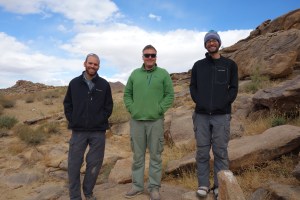
Our new buddies
Our new buddies

We were also happy to have Matan and Iftach with us for the feeling of camaraderie and security. As you may know, all Israeli people must serve in the military. These guys had gone above and beyond by extending their service by a couple of years and by volunteering for combat units, which you would never guess by their calm, warm demeanours. This was comforting to Luke and I, owing to an experience from our first night in Mongolia.

I wasn’t totally forthcoming when I said that Luke and I checked into a ger camp when we got to Mongolia. We did, but not until 2am. Our first attempt of a sleeping place was at the house of a fellow who we met in an insurance office at the border – a cheery guy named Joy, who invited us to stay at his home. We had heard that this is common in Mongolia – you give someone $15 or $20 to stay in their house for the night and eat dinner and breakfast. Joy had stickers all over his motorcycle that had been given to him by travellers – an Australian flag, a Mongol Rally sticker from last year, a British car parts company.

In his cosy house on the edge of Tsaaggannuur, we met his charming elderly mother, his sister, and her adorable toddler daughter. We had a few gallons of tea and some food. All was well, and we felt comfortable. Luke skooted off to bed early, owing to his flu, but I felt safe because there were no doors and I could still see him. I stayed up for a while, playing with the baby. Some of Joy’s friends came round and had a couple of jovial beers. Joy bragged that one of the fellows was a champion wrestler, and I jokingly asked for a demonstration.

This is a video! Press to play. The Grandma and I played this game of “Where’s Koala?” with the little girl for about an hour. 

I didn’t notice anything amiss – I was showing the little girl videos of Rory and James in the ocean – until Joy grabbed his wrestler friend by the scruff of the neck and dragged him outside. I heard shouting, and figured they had had a bit too much to drink and decided to get dramatic. No big. I hung out with the baby. Luke heard the shouting and got up, and then mom and grandma went outside, leaving us with baby. It was midnight. The shouting escalated, and mom and grandma came inside, sitting on the bed next to Luke, baby, and I. It started to sound scary out there – there was no laughter in those shouts. Luke and I clearly weren’t involved in their fight in any way, but we were worried that someone would remember we were around and get us involved. We decided to leave. Grandma protested at first, but finally, when the group of men outside quieted and seemed to have left, she seemed to give us her blessing to go. She walked us to our car, kissed our foreheads, and waved as we drove off into the bright night.

We drove for an hour to get to Ulgii. We rolled up to the ger camp at 2am, and called the office phone number. They blearily admitted us and showed us to some comfy beds. In the morning, we apologised, paid for the room, and took a nice steamy bath in the aromatic wooden Russian bathhouse. (Basically a private sauna where you sit on a wooden bench and pour buckets of hot water all over yourself – magic.)

So, you can see why we would feel better having a couple of trustworthy, entertaining, military officers with us after that.

Perhaps feeling risk-averse, we decided to take the southern route from Ulgii to Ulaanbaatar. This meant avoiding the deep river crossings and mud of the northern route, but missing the mountain charm. Instead, we drove next to the Gobi desert, in a bizarre and maybe gorgeous lunar landscape. The road, blessedly, was paved half of the time. The other half, Luke enjoyed testing out our new tires on some excellent off-road terrain.

Which way to go?
Which way to go?

We only had two small river crossings and never enough sand to get stuck in. We did enjoy choosing our tracks – there were usually 6 or 7 running roughly parallel through the grass. And it was fun to navigate by saying things like “We need to drive to the right of that rocky hill” or “We’re heading too far north, bend south at the next available track” or “Stay with the main track – there’s a river crossing in a kilometre”. From a navigator’s perspective, this really beats “Turn left in 300 metres onto Union Street.”

We had a couple of interesting “city” moments along the way. In one town, we stopped for lunch. We usually made our own lunch out of stores in our “cupboards”, and we wanted to add some cheese to the mix. So we stopped at a small store – no cheese, but there were instant cup-o-noodles which were perfect for cold bones on a rainy day. We went outside to make our food by the car (with interested locals looking on), until Matan called, “Hey guys, um, I think she wants us to eat in here.” So we cooked our instant noodles on the shopkeeper’s living room/bedroom/kitchen floor, and shared our Israeli coffee with her and another fellow who showed up for the action. We gave her an Australia-themed tea towel before heading back out into the rain.

In another town, we were quite happy to find a hotel for the night – it was a tiny place. Seemingly every window on the building was broken, but inside, the place was quite charming. We paid for our rooms, and then, as an afterthought, asked where the toilets were. They were a pit out the back of the building – so Mongolia. And the shower, boy, that was an adventure. The shower was a 5 minute walk away, to the other side of town, past cattle and goats being herded down the dusty main “street”, through the gates of the boarding school, into a small building with 3 shower stalls and a student collecting money. We paid for our showers and, on the way back, waved at all the students calling to us from their dorm windows.

We're not in Kazakhstan anymore, Toto
We’re not in Kazakhstan anymore, Toto


The camping was no less interesting. Our first night, we camped in a vast, empty plain. It was still as a crypt, until 4am, when the quiet plain became a whirlwind, threatening to carry us and our little dog Toto far into the Gobi desert. It was unsettling. Luke and I got up at about 6:30, packed our tent away, and rested in the front seats of the car.

dsc06488
Digging ourselves into a pit

The next time we camped, we found a pit. Like, an actual rock quarry that had been dug by excavators. Luke and the guys used our collapsible shovel to dig us a way through the dirt barrier, also created by excavators, and we drove right down into our cosy, windless, campsite. This is the sort of thing that happens when Luke gets all excitable about an idea and won’t give up.

And finally, we make it to Ulaanbaatar

Ulaanbaatar is the type of city where meandering livestock slow traffic on multi-lane roads, but there is also a Pizza Hut. Sadly, we’ve seen very little of the town as I’ve got an awful flu, and Luke is just getting over one. Add to that my body’s decision to have my first, ahem, digestion, issue of the trip while waiting in line at the Mongolian immigration department to extend our visa. Blessedly, there was a toilet. However, the stall door was 6 inches from the end of the toilet, so I had to sit sideways. The bonus was that this made it really convenient for leaning my sweating forehead against the nice cold tile wall. If you are disturbed by this picture, I will remind you again that you exercised your free will in reading a blog post about budget travel in Central Asia. You have only yourself to blame.

So, we’ve been spending most of our time here in UB (as the cool travellers call it) holed up in the the most cozy hostel. Our room opens onto a friendly kitchen, dining room, and living room with big fluffy couches. Travellers, mostly Israeli, hang around at meal times, when we chat about where we’ve been and where we’re going, and swap advice about visas, roads, tour companies, food. It feels a bit like the Peace Corps houses, where volunteers get together to feel a slice of home. It’s quite comfy.

In addition, Israelis seem to have an instinctual understanding of not bringing up a country’s embarrassing politics if not first invited. As a person who currently is enjoying hiding under a rock regarding American politics, I appreciate this camaraderie.

Your friends, the dummies

We’ve found that stupidity is an excellent tool while travelling. Our favourite example (so far) is when we were stopped by some Russian cops in the Altai mountains. There are lots of routine checkpoints set up on Russian roads; a cop just waves you over and looks at your paperwork. We passed one, and the cop waved, but we were pretty sure it was for the person in front of us, who stopped.

However, the next cop, 200 metres down, definitely waved for us. It turns out, through the cop’s very limited English, we were supposed to stop before, AND we were speeding. It was pretty clear. But, you see, getting a ticket in Russia is a pain in the butt. You have to drive to the station and pay your ticket, and you have to go during office hours. So, Luke and I snapped straight into our super-friendly touristy stupid mode. This is unnervingly easy for us.

We smiled a lot, and happily exclaimed “Australia!! Tourist!!” a lot while pointing to ourselves. We heartily agreed with the cop when he said the word “stop”, pointing to ourselves and him and agreeing that we stopped when he told us to. “Da! Stop! Us!” He was pretty good natured about it, but clearly thought we were the biggest, happiest, idiots he had ever met in his life. He started doing charades for writing us a ticket, probably to tell us he could if he wanted to. I said, “Pen?? You need pen??” and cheerily went into the car to get one. When he saw me emerge with it, his eyes got wide with realization and his shoulders slumped, and he said, with all the exasperation you can imagine, “Oh. Pen.” He then shook his head and walked away. We, the cheerful idiots, were free to go.

The next time we employed our stupidity enjoyed less success. As you probably know, land borders require you to both leave your current country (Russia, in this case), and enter the new one (Mongolia). Leaving Russia, we got our most thorough car search yet. Usually we see local cars getting searched, but we just open our doors, smile, show them our bed, and get waved ahead.

This time, we had four Russian police search every item. This was ok until one, the mean one who never smiled, said “Medical. Doctor.” We couldn’t play stupid for too long on this one; he wanted to see our medical kit. This was not that fun – we have all completely legal drugs, but we have a lot. Cold and flu drugs, regular medications, pain meds, antibiotics, our prescription meds, everything for any type of stomach bug you can imagine. And all of this in large quantities for a year of travel.

dsc05932
Kitten break! At our campsite in the Altai Mountains

The officers were not amused by our stores. That is, they weren’t until they asked what one particular bag of drugs was, and Luke launched into charades for diarrhoea and vomiting. This elicited smiles and giggles from most of them. The charades took a sour turn with Luke’s vitamins, however, which we described by flexing our biceps. The officer looked shocked and said “Anabolic???”, which we quickly denied (they really are just magnesium tablets). I laughed and looked appalled at the suggestion, which actually wasn’t feigned stupidity – it really would be incredibly dumb to try to smuggle big bottles of anabolic steroids across the Russian border.

Interactions with the locals

We have mentioned previously that people in Russia are not particularly ebullient. This does not extend to the Altai region, where people are super nice.

For example, we stopped at a little stall along a shady wooded section of the Chusky Trakt to get some lunch. A fellow was barbecuing some pork, which turned out to be delicious, by the way. He told us to sit on a little picnic bench while he got our food together, and, once it was done, he came and sat with us. We had a pleasant chat without any English. Turns out the tea we were drinking was made of 7 herbs, harvested by hand by this fellow, from the forest we were sitting in. He was very interested in us, and how we came to do our trip. He asked (by miming “fat pockets”) if we were rich, which is a pretty amusing and common response when we tell people what we’re doing. It’s hard to know what to say. We usually just laugh.

Another time, at the Mongolian border, I was reminded of what it feels like to be a spectacle in a place where one is very, very different. My blue hair probably doesn’t help that much. Luke was with the car, and I was waiting for him to pull around to pick me up. There was a group of about 30 people waiting, looked like they had all been riding in the same bus. One of them said something friendly to me, and the whole group stopped talking and turned to look. I smiled that I didn’t know what she was saying. They all laughed. Someone said “Kyrgyzstan!!” and pointed to the whole group. Someone else walked up to me and handed me two pears, and they all watched while I ate one. It was all very good natured, and made me want to go to Kyrgyzstan.

Less good-natured were the stares we received when we walked into the breakfast lounge of a truck stop hotel in Russia. We accidentally decided to have breakfast at the same time as a Russian football team who were staying at the truck stop too. They were not hostile, but they were certainly unamused by us.

Till next time

We look forward to several more days relaxing here in Ulaanbaatar, until Luke’s sister Jo joins us next week. She’s made the brave decision to join us on our drive through China – a whole month of Felice and Luke, lucky her? We’ll keep you posted!

Bonus feature: A map of where we’ve been this time, because no one should be expected to know the geography of Central Asia off the top of their heads.

The Altai Mountains

Mongolia

Mechanic-hopping and new friends in Kazakhstan

I’ll start this post by explaining how we ended up crashing a grandfather’s birthday party in a home in the Kazakh village of Akmole.

img_5752
We’ve finished breakfast at our fancy hotel in Astana, and are ready to get back on the road!

We had been in Kazakhstan for about a week, having crossed the border from Russia easily and seamlessly (more later). We had spent four illuminating days in Astana, the new capital of Kazakhstan, getting a Chinese visa (more later, again), and getting some car repairs (of course, more later). We were just heading out of the city, with clean clothes, phone credit to spare, food stores topped up, and a good night’s sleep under our belts. Just needed to top up on fuel and we would be good for days of free-camping, which we are now quite used to doing.

In Kazakhstan, gas station attendants pump your fuel for you. You just go inside and pay, and a computer tells them how much and what to pump. So I told the front counter to give us 50 litres of diesel. Once filled up, we drove off.

3 kilometres down the road, Luke got that look on his face. Not a good look. “Engine’s a bit rough”, he said enigmatically, as the car spluttered to a stop. Luke coasted nicely off the road and we got out to investigate.

I’m darkly proud to say it was me who figured it out first, though Luke was only seconds behind. They put petrol into our diesel engine. Cue gasps from people who know that this is VERY BAD NEWS. If you didn’t gasp here, you should know that this can spell the end of an entire engine. As our friend Andrei says, “Caput. Caput.”

And this is where elements of luck and miracle start entering our story with an unbelievable frequency.

img_8018
In Andrei’s car

We had pulled off next to a tire shop. At the tire shop was a group of men, one of whom, Andrei, ended up being both a German-trained mechanical engineer – he now owns a fleet of trucks which he has custom built, but has also run a fleet of high-rise construction cranes – and one of the kindest human beings on the planet. Andrei didn’t get it at first, as he speaks German and Russian but not English. We marched him over to our car and made him sniff the fuel cap. Once the realisation dawned on him, he, I think it is fair to say, Freaked Out. He put us into his car and drove us back to the fuel station, our car remaining forlornly on the side of the road. We had a fairly polite shouting match with the fuel attendants. Andrei is a persuasive guy. He said the manager would arrive in 30 minutes, and in the meanwhile, he drove us to a mechanic friend of his, who gave us the skinny on what the possible prognosis could be from this fiasco. There were two options: not-too-bad or scrap-it-and-go-home.

After returning to the fuel station, we picked up the station manager – who, it turns out, was a good guy and wanted to help. Probably more of Andrei’s magic. We returned to our car to tow it – using one of Andrei’s fleet trucks – to the mechanic. This involved Andrei stopping 4-5 lanes of traffic (you never know how many lanes are really there, in Kazakhstan). The mechanics looked at it right away, with the gas station manager hovering nearby.

img_8004
Andrei directing traffic to stop while his truck pulls our baby

To cut a long story to medium length, we checked in on the mechanics every hour for a few hours. Each time, the prognosis became more optimistic. The gas station manager was paying for every bit of work. The mechanics were draining the tank, replacing the fuel filter with one of our spares, and flushing out the entire fuel line. The only thing that seemed to save us here was that we had half a tank of diesel left, so the petrol didn’t get too far into the motor. Also, that Luke had stopped as soon as he sensed there was a problem.

While we waited for the mechanics to do their voodoo, Andrei had to get some work done, and kindly took us along with him. He had parts to pick up, mechanics to supervise, and just generally seemed a competent, efficient, and jovial business director. We got to talk to him quite a bit through google translate, charades, broken German, broken English, and photos on our iPhones. We had a great time, surprising given the situation.

Once we had the car cleaned out, healthy, and ready to go, it was about 6pm – too late to leave the city and camp, so time to find another hotel in Astana. But Andrei had other plans – we were to go to his house, about an hour outside of Astana (or 10 minutes the way he drives), where they were having a birthday party for his father-in-law. We would spend the night with the family and leave the next morning.

img_8048
Our new friends – from left to right, that’s Andre’s sister, her husband, Tamara’s Dad, Andre’s friend and his wife, Andrei, Tamara, and Luke

fr

We were more than happy to accept the offer, and we are so glad we did. Andrei’s family and friends are wonderful people who we will remember – and hopefully keep in contact with – as long as we have functioning brains. His wife, Tamara, speaks English, is an electrical engineer, and is crazy smart. I’ve never heard anyone pick up a language as quick as she did with us. Their daughter, Maria, is 8, and is adorable. She showed me pictures of her recent trip to Crimea with her Grandma, and of parrots she had seen in a zoo. The party attendees were a boisterous, good-natured group. They were very curious about our trip, and made sure we were eating and drinking heartily and continuously, with intermittent toasts. Andrei’s family seems to be a group of highly intelligent, extremely open people – the type who give you solid eye contact while they ask you insightful questions, in Russian or otherwise. They also scolded Luke for allowing his wife to do things like have blue hair and a tattoo. This was not behaviour they would allow of their wives, they happily explained. We also got advice from Andrei’s friend, the local police chief, to not try to bribe cops here in Kazakhstan. It’s a dangerous thing for foreigners to do, apparently.

img_8062
Look at their gorgeous garden!

Their house was gorgeous. Huge, well decorated, with a bountiful, enormous kitchen garden, and adjacent to a vast expanse of dramatic steppe. Andrei’s sister lives right next door; she had us over for a fancy tea where I was given rum that got me nice and toasty for the afternoon’s drive. Perhaps it’s because they have a police chief as a close friend, but they did not allow Luke to drink. What a relief.

Our hands laden with gifts from the family of Russian vodka, Kazakh chocolate, and home-grown vegetables and eggs, Tamara and Andrei showed us down the road and we finally said goodbye. It was like saying goodbye to our friends and family at home when we left for this trip – heartbreaking. Now, we will just send emails, and plan to return to visit in years to come, next time perhaps with children.

But wait, there’s more

Tamara, Andrei and company showed us exceptional hospitality that has made me love Kazakhstan perhaps more than any other place we’ve visited. But they weren’t the only ones. There’s a direct correlation between car repairs and Kazakh hospitality.

The first Kazakh friend was a young guy we met in a market, where we were shopping for – you guessed it – car parts. (New all-terrain tires, an extra air filter and some fuel filters, if you care.) He called us over to his stand and had a good chat with us. Our favourite google-translated phrase from him was “I am pleased with you.” He did invite us over to his house, but we were at that point consumed by car stuff and also did not yet understand the genuineness of Kazakh hospitality.

img_7973
With Bekzan, one of our friendly Kazakh guides

The second Kazakh friend we met through meeting his father at the tire shop where we were getting our brand-new BF Goodrich all-terrain tires, which, by the way, we love. Enquire for technical details, because I actually know and can tell you. Anyway, we were getting our wheels aligned and they told us some bolts on the wishbones were shot. We didn’t get a word of what they were saying, so a fellow called his English-speaking son. He ended up meeting us at our hotel the next day. We thought he was a mobile mechanic. Nope. He was just a super, super friendly guy. A recent college grad who was just about to take a test to enter training to become an air traffic controller. He came with us to the Chinese embassy to pick up our visas, and then he and Luke took at 6 hour journey through Astana to pick up car parts, visit mechanics, etc. They got some new bolts put in place. I stayed home in our cushy hotel, as our car only has two seats. I spent most of the day emailing people at home and telling them that Luke was on a mystery tour of Astana. We had a late lunch together when Luke and Beksan returned from their saga.

img_8123Other Kazakh friends came after we found out that the new bolts were not right. We found this out while almost losing our steering entirely (but not quite). Luke checked the car out on one of the ubiquitous roadside ramps, and couldn’t figure out what was up, so we looped back to a tiny village. We happened upon some guys in a security truck. Kazakhstan is the type of place where the don’t give you directions. They take you to where you are going. The security guys took us to a mechanic, who didn’t have the right tools. So the mechanic took us to another mechanic. These mechanics were great. They did the work right away – one of the bolts needed to have an extra spacer welded onto it, as it was jiggling, causing the wheels to be wildly out of alignment. They charged us a pittance. Then another mechanic went to collect his wife (who speaks English) and adorable baby. We took photos together.

Another Kazakh friend, non-car-related, was a gorgeously strapping fellow (the rumours are true – Kazakh people are super attractive). A director at an up-and-coming Chinese airplane engine company, we met him and his equally tall and attractive friend at the Chinese embassy. To pay for your visa, you have to walk across the city to a bank. Being Kazakh and not content to merely give directions, he walked us all the way there, in the middle of a busy work day.

In some ways, we hope not to make more friends in Kazakhstan, because that probably means something else has happened to our poor car. Perhaps it would be worth it, though.

Lessons learned, thus far

Our takeaways from all of the car stuff, by the way, include:

  • The two most important rules of overland driving: Don’t Hit Stuff, and Pump Your Own Fuel. Both things we knew before, of course, from Luke’s farm education by Ken, mostly.
  • We are firmly in Asia now; where car problems are generally solved by hammers and welding, and it is necessary for one to watch the mechanic at all times. That’s not just us, it seems to be a cultural norm. Being a mechanic here involves much more performance art and sociability than at home. Also, one should be prepared to make at least 3 mechanic trips per one car problem.
  • More lessons to come, I’m sure. Even as I type this, we are bumping down a potholed dirt “highway”, and Luke’s not totally convinced the alignment is right yet. But that’ll be just more stories to tell y’all, I guess.

Unnervingly easy

Just last night, Luke and I were discussing the fact that we feel like frauds. Overland travel is supposed to be laced with potential dangers, annoyances, 8 hour waits at border crossings, bribing police. It’s supposed to be HARD. We figured it had been easy in Western Europe because Western Europe is just easy; but we are bewildered to find it’s also been easy in places like Bosnia, Russia, and Kazakhstan. It’s a bit unnerving; perhaps all of the stories that make overlanders sound like badasses will happen in Mongolia and China? Maybe we just aren’t there yet?

Case in point – our Chinese visa. We planned to get it in Ulaanbaatar, Mongolia. However, I called in advance (for the 3rd time, just to triple check), and it turns out they are no longer issuing visas to foreigners. We panicked for a time, until we learned we could do it in Astana, Kazakhstan. Apparently it’s a nightmare – line up at 5am for a 9am open time, shove past Kazakh hordes, be interrogated by expressionless Chinese officials, wait days and then more days. Sometimes they don’t give visas to foreigners at all.

But it was easy. We arrived at 8:50 and were shown right in by a smiling security guard, past a few waiting people. We waited 10 minutes to be seen. They didn’t even ask us questions. They took our visa applications. Our aforementioned handsome Kazakh took us to the bank. We paid. We went back two days later, our friend Beksan in tow. This time the smiling guard laughed and made jokes at the horde of people waiting in a pack in a windy area; he made everyone move back but pointed out Luke, Beksan and I to break through the horde. We had our perfect visas within 5 minutes.

And the borders! It seems like going from Russia to Kazakhstan would be tricky, right? The Russian side was relatively quick and efficient. Despite the presence of a 5-acre car park for waiting, and an electronic booking system, we waited not at all. There was no one there. It took 1 hour, 3 checks, all easy. A guard even smiled once. On the Kazakh side, the smiling border guard said happily, “Welcome to Kazakhstan!” and “Australia, kangaroos!”, and shook our hands. He then assigned another traveller, a Kazakh fellow, to show us how to get through customs. He took us into the passport control building and directed us to cut in line in front of 3 or 4 waiting people, who politely said nothing when we did so. The next inspecting guard separated Luke and I, which wasn’t great. He made me stand 20 metres away while he directed Luke to turn on our camera, so he could look through our holiday photos with glee. Odd, but easy.

In a few days we’ll be going through the Russia-Mongolia border. We’ve heard it’s usually an 8 hour wait. We’ll let you know.

About the steppe

Today we have left Kazakhstan, back into Russia again. We’ll only be here for 4 days or so. We’ve just got to get across to Mongolia – Mongolia and Kazakhstan don’t touch. One must go through either Russia or China to get between them. Anyway, we want to tell you about Kazakhstan now that we’ve left.

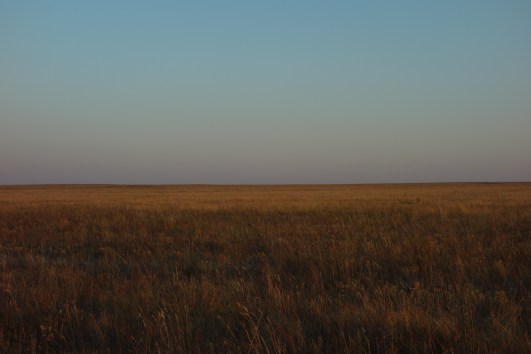
dsc05448Firstly, Northern Kazakhstan – we’ve only been to the north – is mostly open, grass-filled steppe, dotted with small dusty villages, with a couple small industrial towns, and Astana. The steppe is beautiful.  When you drive off the road, you crush herbs underneath your tires, creating a delicious perfumed cloud around you. This is perfect for those who shower infrequently. Sometimes, it looks just like Australia, with the wheat fields stretching into the distance. Our campsites often even sound like Gowrie (Ken and Sue’s farm), with the trucks going past in the distance. Perhaps this is why we inexplicably feel safer in Kazakhstan than in Russia.

The steppe is beautiful, but boring driving. There’s not much to see – a curve in the road is exciting. A shadow from a cloud overhead is a notable addition to the landscape. We are very thankful when we pass a little village or cemetery to look at.

About Astana

dsc05609
That’s the Bayterek in the middle there – the short beautiful monument building, the symbol of Astana.

Astana is the capital of Kazakhstan and the showpiece city of Nursultan Nazerbayev, who I like to refer to as the country’s “friendly dictator.” (He has been in power since the collapse of the Soviet Union, and has been largely a very positive force for the country.) If you tell someone from Astana that their city is beautiful, they invariably say, “Yes, it is new.” And this is true -it’s only been the capital for 20 years, moved from the older southern city of Almaty, apparently to be closer to Russia.

I think we saw Astana mostly as Nursultan Nazarbayev would want us to. We stayed in a glitzy hotel, affordable but not insultingly so, with polite, multi-ethnic and English speaking staff. We were in awe of the enormous, architecturally inspiring buildings. We were daunted by the scale of the city, as we realised that walking 5 blocks requires an hour. And the Kazakh people, as you have read, really turned out.

There was also the weird side of it being a new city. Huge new apartment blocks, all around the city, were empty and had no shops, schools, or roads around them. Big spaces felt abandoned. Many of the main roads had no line markings. The most lived-in spaces were in the older parts of the city, in markets made out of shipping containers and in traffic-congested suburban streets. Most tourists probably don’t go to those parts. But us, we needed car parts.

The end of Russia

Kazakhstan: From Russia, to Aktobe, to Astana

Astana

Our adventure with Andrei, and outside of Astana


Russia: Not what we expected

To be totally honest, we were afraid of Russia. It sounded like a repressed, dictatorial, scary place that only serves cold sour soup and starchy potatoes. We were told to expect suicidal/homicidal maniacs in place of sane drivers, and that random police searches would become part of our daily routine. We bought a carton of Marlboros in preparation. We wondered whether there would be paved roads. We thought Moscow would swallow us into a belly of colourless concrete, speckled with lurking shadowy bad guys and overly-glitzty women. After all, didn’t Eve’s Russian dishwasher repairman say to us, directly: “Russia is shithole. Why you go there?”

Moscow, sparkling like a jewel

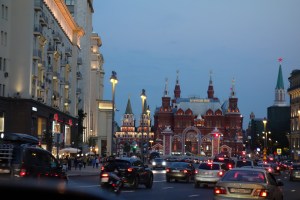
With all that build up, I’m sure you can guess my next literary move. Russia is decidedly NOT a shithole. Sure, there are some rough corners. But Moscow glitters like sea of sparkly pastel jewels, with elegantly lit bars, shiny expensive cars, and delicate white detailing on stately pink, seafoam, and peach buildings. It’s the cleanest city we’ve been too, bar

Pretty pretty Moscow

maybe Monaco or Luxembourg. It’s charming and largely liveable. And surprisingly western – it has Starbucks and Duncan Donuts and a Spongebob Sqaurepants themed restaurant. It even looked like they actually bought the rights to use Mr. Squarepants legitimately.

An oversize public tea party on the pedestrian concourse lining the central Moscow ring road


The countryside is filled with trees, gold-topped candy coloured churches, trees, houses in primary colours with ornate wooden window trimmings, and trees. In addition, there are many used-tire retailers, semi trucks, and also trees. I forgot to mention the abundance of trees.

For example, Luke had a pooping problem (don’t get mad at me, you’re the one who signed up to read an overland blog), so we had to make an emergency stop about an hour outside of the centre of Moscow. We ran into what turned out to be a fancy sushi restaurant, which had an American-size menu and every type of sushi and vaguely Japanese-related food that we are accustomed to. I definitely didn’t expect this sort of thing of Russia.

That being said, things aren’t all stereotype-busting. There’s the lack of smiling that I mentioned previously. There are definitely way more police than any other country I’ve been to, though we’ve only been pulled over once and it was a quick routine check. Everyone seems to be wearing army fatigues, like as a fashion thing, but we have trouble telling who the real army people are. There are more rifles hanging off people with shoulder straps than I would like. Of course, the Soviet apartment blocks are omnipresent and dreary. We have to beg and cajole hotels into doing the registration paperwork required for foreigners. I don’t know what’s happening behind people’s apartment doors, or behind Putin’s office doors, but I’m guessing it’s not all sunshine and roses. And we have seen antics by drivers so dangerous, rivalling and sometimes topping Italy and Latvia. Luke is probably proud of himself that he has only flipped one bird thus far, and that was because a person was literally 6 inches from hitting us. Otherwise, Russia is perfect.

DSC04774Let’s talk a little bit more about Moscow. By accident, we slept next door to the Kremlin. I was just trying to find a hotel with secure parking; I succeeded. The hotel was on the innermost Moscow ring road (of about 10 concentric ring roads, might I add). We could see the Kremlin from our window. We were just drifting off to sleep the first of our two nights there, when we heard explosions coming from the area of the Kremlin and Red Square. I leapt out of bed – it was fireworks. Beautiful fireworks over the Kremlin. Magic. Speaking of the Kremlin, it is gorgeous. Putin wasn’t there; apparently he hangs out mostly outside of the city these days.

We have had a few adventures, though.

Our first breakdown

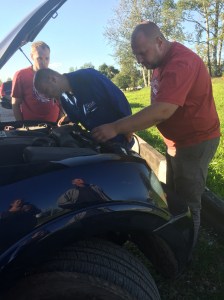
Firstly, I’ll say that I am decidedly not a car person. Luke, thank the heavens, is. He’s like a dog whisperer, for engines. He’s uncomfortable with, and disagrees with, that praise. Anyway, even I know that when something starts banging around under the hood like a hammer in a dryer, and your engine begins to squeak like a Belieber, it’s time to pull on over.

The goddess of engine troubles was clearly smiling upon us this day, though, because the first opportunity to pull over – about an hour north of Moscow, by the way – was, from what we could tell, a semi-truck repair warehouse. We diagnosed the problem as well as we could (and by that I mean Luke diagnosed it while I held the light). We did find the air conditioning belt had flown off and wrapped itself around the main radiator fan, and we found another belt had been pulled off and stripped into shreds.

But it was no good – we needed help. I went over to the ancient guard man sitting by the entrance and asked if he spoke English. Like most people, he just nodded in the affirmative and fixed me with an unreadable gaze. Yeah, definitely no English. But, a few minutes later he came ambling over, took a look at the engine, motioned for us to wait, and got on his phone. Another guy shows up to look at the car. This guy’s more gregarious, and keeps speaking Russian, telling us stories and jokes, we’re guessing. Both guys don’t understand the idea of google translate, so that’s no help. We pretend to listen for a while, and I frantically try to call up Helen, Eve’s au pair, who speaks Russian, for help.

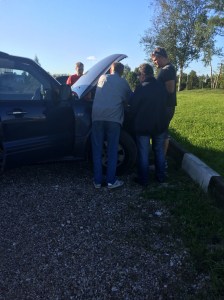
A few minutes later, a couple more guys show up. For the third time, Luke shows off the engine. A few minutes later, another 2 or 3 guys show up, a couple in mechanic’s overalls. At this point, we’ve got a flock of Russian mechanics crowded around the car, debating with one another. Thankfully, one has a few words of English, but most critically, knows his way around google translate. They all bend over the engine (one with a cigarette dangling out of his mouth), and eventually come to the conclusion it’s safe to drive. They point to a spot on google maps where we can get it fixed the next day. We tossed a few of them boxes of Marlboros as they went, so they could dangle them over other engines. Better to give thanks than bribes.

I should mention the best part of this whole experience. Remember the original ancient security guard who I asked for help? He spoke no English, but he did speak German. Given the extremely complicated relationship between the Russians and the Germans (and the whole extremely bloody battles during WWII, German betrayal and invasion, etc.), we were very intrigued by how he might have learned German. And he was DELIGHTFUL. While all the mechanics were looking at the car, he and I were standing back. A phone rang, the tone an upbeat little ditty, and he started doing a hidden little dance – just a shake of his hand – and winked at me. Not in a creepy way, in a Grandpa way. He looked like he was saying goodbye to his grandchildren when we left.

Anyway, we gingerly drove our baby an hour into Moscow, and back out into the garage in the suburbs the next day, as she squealed and hissed and just generally gave us heart palpitations. Thankfully, though, all was well in the end. The garage was a large, clean, modern Mitsubishi dealership. Efficient mechanics took care of her right away. They kept us abreast of the situation through a combination of google translate and a mechanic who spoke English (on account of a previous career as a Boeing airline mechanic). We sat in the cushy waiting room, snacking from the vending machine, for a few hours. The bill was cheap. They even cleaned the car for us.

(For mechanical details, please enquire. It’s boring for me.)

Our first free camp

Many of you are acquainted with our dear friends, Michael and Shosh, AKA our wedding officiants. They are a major reason we’re on this trip at all – they have done two overland bicycle holidays in Europe and encouraged us on our overland ambitions. They may judge us slightly for our choice of motorised vehicle, but we all have our differences. Anyway, one thing they told us would be FINE is free camping – i.e., just pulling off the road and sleeping in a nice spot. Other, vehicle-supported overlanders also say this is fine. It’s cool, they say, I often just pull off the road in Uzbekistan/Columbia/Mongolia and pitch a tent. No big deal. You can too.

So, inspired by these super cool people, we tried it. We pulled off the road in Russia and slept.

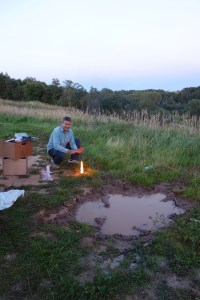
Classy scene. Luke warms his hands by our mud puddle.

To be more accurate, we pulled off of the road 3 or 4 times until we found a suitable spot, out of view of the road and not, as far as we could tell, going to anyone’s house or anything. We engaged our 4WD and chose a nice little flat spot with a view of a valley and river. Charming extras included freeway noise, a mosquito-infested mud puddle, and trash from all the previous campers. The most scenic of this last category was a used condom. Excellent.

We didn’t sleep too well, this first night of free camping. But, we love our bed and the free price tag so much that we will definitely do it again. We feel flushed with the success of not being murdered, mugged, or mauled by a bear.

After all, the cool kids do it all the time, so it must be fine.

Our first off road adventure

Our TomTom app, bless it, told us that we were about to hit some heavy traffic heading into a town – about 40 minutes added to our journey. So we decided to take a “short cut.” Actually, it wasn’t a terrible idea. We did pretty well. We only added about 35 minutes to our journey.

And we got to do some excellent off roading – splashing through mud puddles, losing traction and fishtailing, driving through grasses a meter tall, spinning the wheels in deep thick mud. A couple times I got out and moonwalked myself over to puddles to check their depth before we made the plunge. At one point, we found it necessary to open and drive through a farm gate, eliciting curious stares from the grandmas inside. At another point, a guy on a bike stopped to bemusedly watch us slip and slide through a particularly muddy section. It’s too bad we accidentally lost our dash cam videos of this, because I was giggling like an idiot the whole time. Overall, the experience made us excited to go through Mongolia, which, from what we understand, will entail 1600 kilometres (1,000 miles) of this type of terrain.

And finally, History

As usual, we’ve been listening to Russian history lessons as we drive. It’s incredibly disturbing. Russia’s history seems to be a never ending wheel of mass starvations, mass slaveries, mass murders, and massively dickhead leaders. Some of the more recent history – in the last century – has given Luke and I a new fascination with old people. If you’re in your 80s or older here, you have seen some earth-shattering shit. I find myself searching strangers faces, like a creepster, trying to read their histories and experiences.

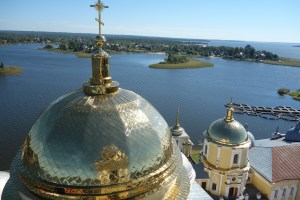
DSC04589Even the most beautiful places seem to have terribly tragic histories. Take this beautiful monastery on an island on Lake Seliger (a few hours north of Moscow, near the town of Ostashkov). We took a boat there, over the calm water and past the green swaying reeds. It’s gorgeous, right? Yeah, during and after WWII, it was a prison camp. For children. (Among other disturbing or odd functions it has performed over the decades.) About 20 years ago it was handed back to the Russian Orthodox Church, and is once again inhabited only by black-robed monks, as well as a steady flow of local tourists.

A more prison camp-esque view

We’ve got one more days in Russia (there’s a couple of days in Russia I haven’t covered in this post). We’ll then hit the border of Kazhakstan, where we expect to drive about 7-8 hours a day until we hit Russia again. Thank goodness for audiobooks!

Pechory and the road to Ostashkov

Ostashkov and Lake Seliger 

Torzhok and the road to Moscow 

Moscow and the beginning of the road south


Romania, Poland, Latvia, and Russia (plus a little Slovakia, Hungary, Lithuania, and Estonia thrown in)

After the back-to-back touristing with Mom and Dad (and very fun touristing it was!), Luke and I were happy to slow the pace a bit when we arrived in Oradea, Romania. Rachel’s partner, Manny, spent most of his childhood in Romania, before immigrating to Australia. Him and Rach were visiting family for a few weeks, and so we joined them at the house of Manny’s parents, Maria and Garby. I’ll tell you all about that in this post, but I’ll also briefly touch on: Hungary, Slovakia, Poland, Lithuania, Latvia, Estonia, and Russia. More later.

Romania: really quite nice

Relaxation on the back porch
Rach and Manny relax on the back porch

First of all, Romania, especially Oradea and even more especially Maria and Garby’s place, is lovely. As we found out, Romania is wooded and full of character. Oradea, a city I had never even heard of, has narrow tree-lined streets, an old town that has both quaint and grand sections, lots of bath complexes, all the services you need, and plenty of

Spoils from the garden

old communist buildings to keep things, hm, interesting. Maria and Garby’s house is on a quiet suburban street (quiet when the neighbourhood guard dogs aren’t having a chat with one another, I should say), with a garden that Luke and I freaked out over. Rows and rows of plump grapes, trees bursting with plums, chickens running around. It was like Eden.

Romania: Taking care of business

We did more than our usual amount of sleeping, but we also managed to achieve many chores. This is a fabulous way to get to know how a community works, as we learned in Louth with Nick and Louise. Post office, doctor, translation service, supermarket, car repair shop (6 times), shopping mall… Manny generously translated everything for us, and sometimes Garby ferried us around, too.

Romania: Millions of Mannies

Maria made us crepes! We got home from the movies, and, boom, there's a stack of crepes. With homemade jams from another family member.
Maria made us crepes! We got home from the movies, and, boom, there’s a stack of crepes. With homemade jams from another family member.

Manny did a count and thinks he has about 150 family members in Oradea. Sadly, we only got to meet a small proportion, but that was still a lot. Rule #1: Romanians will feed you. Sometimes chunks of pig fat. (Luke reports that this was delicious.) Sometimes, a full meal at midnight after seeing a movie. Orange soda seems to be a constant, to which I give my stamp of approval. Manny’s family was warm and inviting and just generally good eggs.

Romania: A hare is spared, this time

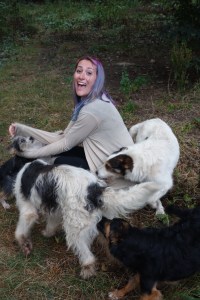
I find it much easier to make friends with dogs than with people. Look at that face, filled with the joy of social acceptance.
Thankfully I do not look, nor smell, like a hare.

Perhaps our quirkiest visit was with Trian. He and his wife, Stella, have a house in town, but they spend most of their time in a hut in a managed forest where he was a forest ranger during his career. He jumped in our car and directed us into said forest. Upon reaching his house, we were greeted by his 7 dogs (ranging from an itty bitty one to an enormous one), who all like to get in on the hunting action. In fact, at one point during the visit, the boys had gone off somewhere and I was standing by myself (happily, I should add). I heard a soft rhythmic thumping and looked around to find a hare, running like lightning, right down the dirt road. Seconds later two or three dogs appeared in the frame, silently chasing. Apparently they didn’t get it because a couple minutes later they ran up to me, hareless and wiggling for a pat.

Romania: Luke gets peed on

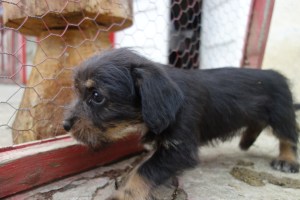
LOOK AT DOSE EYESSS!!

The house’s other inhabitants included a flock of hissing geese and a couple of teeny-weeny-tiny-baby-puppies (one of whom decided to pee all over Luke’s shirt). The neighbourhood was also fascinating: the only neighbour for miles, right across the road, was a vacant house that used to belong to Romania’s dictator during Communist days. Apparently the ruler only came once, but his soldiers used to hang out there and hunt boars. The house also hosted secret meetings of the nascent communist party, then rebels trying to figure out how to take over the government. They succeeded, clearly.

That house, of communist fame

Romania: We learned stuff

If one looks very carefully, one can detect slight differences between the architectural styles of these two Oradean buildings.

Oradea, and Romania in general, is a fascinating blend of leftover communist-era relics (both physical and social), old stuff, and modern capitalist stuff. Our favourite supermarket was bigger than a Walmart, and the shopping mall would pass for a Westfield any day. And we saw Ghostbusters, which we are thankful to report was NOT dubbed into Romanian. All of that is interspersed with evidence of the communist past: monolithic apartment blocks (to better keep watch on the inhabitants, Manny says), the labyrinth of enormous steam pipes for heating said monoliths, the building in town where people were “questioned”, enormous disused factories. Manny patiently answered our invasive questions and explained the difference between the Warsaw Pact (to which Romania was a party) and Soviet Union (to which it was not).

Romania: We did stuff

Of course, we did manage to take a lil’ mini vacation during this holiday within a holiday. Rach, Manny, Luke and I hit the road for 4 days, heading down to Retezat National Park, a few hours south of Oradea, with a few stops along the way. This trip included:

  • I can attest that these are absolutely delicious.
    I can attest that these are absolutely delicious.

    Two nights at a mushroom farm, or, more accurately, a mushroom depot. People find mushrooms in the woods and bring them here to be exported. We got a little tour from the owner and ate our meals on the back patio with what seemed to be workers and family, and a few stray Retezat hikers.

  • A very intense and incredibly beautiful full-day hike towards, but not all the way to, Mount Retezat itself. This involved scrambling up and down steep slopes, waiting for sheep to cross our paths, and mentally preparing for a bear and/or viper attack. (Last one is just me, I think.) We also found a fantastical red polka dot mushroom, which, upon being shown the picture, our host declared as perfectly deadly. One lick and you’re toast. Good thing we didn’t give it a bite.
  • This house has flags of all the western, English-speaking countries, in little frames. The USA takes pride of place, but the UK and Australia also feature.
    This house has flags of all the western, English-speaking countries, in little frames. The USA takes pride of place, but the UK and Australia also feature.

    An introduction to the flamboyant, over-the-top houses of the Gypsies. When Sasha Baron Cohen used a (real) poor Romanian Gypsy village as his setting for his repulsive but guiltily hilarious movie Borat, he conveniently left out these grandiose, sparkly mansions.

  • Checking out a major tourist attraction: bison. These bad boys drew the crowds, comparatively speaking for rural Romania. They just stood there, but they were fuzzy and Luke and I have plans to get a friendly one and cuddle with it on chilly nights. It will take up about one quarter of our tiny house.
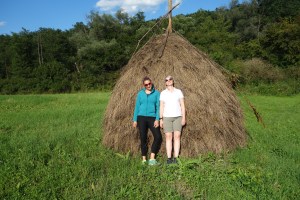
  • Popsicles. This is the new name for Romanian haystacks, rechristened by Rach and Manny. We enjoyed watching them being built; it’s a family affair with Grandma standing on top and smooshing while others toss.

    Popsicles! Get it?
    Popsicle! Get it?
  • Unending road works. For some unknown reason, the powers that be have decided the best way to “fix” a road is to demolish one lane, dig a meter and half down, and leave the long pit there for a few hundred meters. Cultural relativism shield, engage.

In general: We are awkward

On a different note, it turns out that a major barrier to cultural appropriateness for Luke and I is the feeding of animals. We do it, usually from the table, and people think we are weirdos. At the mushroom farm, a toddler shooed away the dog we were feeding with our leftovers, so that smarted a little. Toddler has better manners than us. But they are just so darn skinny and adorable, we can’t help it.

Now, for Hungary, Slovakia, Poland, Lithuania, Latvia, and Estonia

So. Cool.
So. Cool.

We left Romania a bit later than we had hoped (blame the car mechanic, as always), so we only had 5 days to get through 6 countries on the way to Russia. This meant several hours of driving a day, and not much time for touristing. We did stop in Krakow, Poland, and also in Riga, Latvia, both of which are lovely. We camped most nights. The campgrounds were more or less like those in Western Europe, with a few quirky ones. The campground in Riga, for example, was an empty field behind a convention centre, with temporary toilets and several massive Iveco trucks kitted out for some serious, Sahara-style overland. At a beautiful lakeside campground in Poland, where we were advised by a friendly neighbour to definitely not drink the water, we noticed a proliferation of number stickers saying, “Cholesterol ’15”, “Cholesterol ’08” and the like. Very curious as to what sort of annual bash might be named “Cholesterol”, and why.

And finally, Russia

I’ll delve more into Russia in our next post, once we’ve had a few more days here. In the meanwhile, I’ll just give a few tidbits:

  • The border was surprisingly easy. We did make a reservation online, (oh Estonia, you’re so efficient), but were the only car waiting, and were called 15 minutes before our time slot. We only went through 4 checkpoints, and I had been told to expect 7. The guards seemed tickled by us. Once again, hooray for an Aussie passport. They didn’t even really check our car thoroughly – they had us open all the doors, but seemed too overwhelmed to do anything further. I guess that’s a good reason to not do any housecleaning for a few days before a border crossing.
  • There is NO English here. Not only that, but people are totally boggled by the fact that we don’t speak Russian. “Why the heck not??? Why are you here, then?” I can hear their internal dialogues asking. Most just continue speaking to us in Russian.
  • No one smiles. We’re at a cafe right now, and I just saw a lady smile at her friend’s comment. Once, a guy in a phone shop giggled when he couldn’t speak to us in English. Otherwise, no smiles. After listening to 30 hours of Russian history on audiobook as we drive, I can see why. I probably wouldn’t be smiling either.

Our new friends

Now that we are a bit more of a novelty item, we’ve attracted some delightful people. Gas stations seem to be the place for this to happen. In Latvia, a tour bus pulled up behind us at a gas station while we were chopping up a salad in the back of the car in the spitting rain. A lady practically ran over to us as soon as the bus stopped, and excitedly peppered us with questions. Turns out she’s French, but speaks excellent English. She was doing a bus tour through Latvia, Lithuania, and Estonia. She was very excited to hear about our trip and take a look through the car. What a lovely character. Joelle, if you are reading this, hello and lovely to meet you! Maybe see you in Mongolia some day!

The most intriguing couple we’ve met were in a parking lot in Russia, near Pskov. They were in an RV, and we realised with astonishment that they had Chinese plates! A large sticker on the side of their camper told us they were driving from Beijing to France and back. We interrupted their lunch (chopping onions in the van) to exchange our stories in charades and map-pointing, plus a little google translate app action. Their van says, in Russian, Chinese, and English, “Hello friends!” and “The world needs us to know each other.” They were like perky, smiling apparations of the spirit of world peace.

We also had a good “chat” to some fellows in a market in the rural Russian town of Ostashkov, who were convinced that we were English (“Tony Blair! Tony Blair!” they suggested enthusiastically), until we showed them Australia on google maps. They then got excited and took pictures with us. And tried to sell us vodka.

That’s all for now

Tomorrow, we’re off to explore Moscow, and will attempt to find the Mongolian consulate and get a visa. We will also be attending a Russian mechanic for an emergency fix-up (more later). We welcome you to perform any superstitious rights you wish to help us through these tasks.

Romania: In and around Oradea

Romanian road trip

Back on the road: Slovakia, Poland, Lithuania, Latvia, Estonia, and a tiny bit of Russia


Guest post: Carol and Tim!

This is Tim and Carol, Felice’s parents, and we have been asked by Felice and Luke to be guest bloggers.  This is quite an honor, and we will make every effort to be as entertaining and insightful as they are, although our chances of succeeding are slim.  We will start by saying that Felice and Luke travel like they’ve been doing this their entire lives.  They calmly make their way through cities and country roads, Luke driving like a professional, dealing with all manner of drivers, and Felice providing healthy snacks and navigating unfamiliar road signs, consistently able to quickly determine where we were and where we needed to be.  All this while still admiring and appreciating all they were seeing, and enjoying each other. They are quite the team! We did find ourselves offroading in Croatia; Felice told Luke to immediately turn left before the next bridge, which put us on a dead end dirt road through a vineyard.  Oops.

Our heroes are also incredibly well organized – everything has a place, and is in its place – grandpa Hal would be proud!  The wonderful custom cabinetry Luke designed and built for the truck makes this possible, and Felice’s endless lists assured every possible need will be met. Traveling with them was so seamless, it is easy to forget the mammoth preparation that made this seemingly effortless travel possible.

Dad and cows with our AirBnB host in Slovenia (near Lake Bled)

Now for our adventures.  We met Felice and Luke in Zagreb, Croatia.  Felice had arranged a lovely AirBnB, and we walked around the beautiful, old city for a few hours before heading to Slovenia.  There we had a remarkable homestay at a small farm with our gracious host, Alma.  Her Mom told us an amazing story about her great grandfather, who had traveled to Alaska in the 1890’s for the Gold Rush to make his fortune.  Against all odds, he not only made it to Alaska safely, but he also  found enough gold to buy the farm they live on today.  They were very proud of their brave and adventurous ancestor.

Lake Bled
Lake Bled

Onwards to Bovecs, Slovenia, where we spent a lovely afternoon on Lake Bled.  We rented a rowboat, and the kindly and strong Luke rowed us around the lake.  We all managed to not fall in, which was a huge accomplishment, given the size of us and the size of our boat.  Tim was quite a spectacle with his ripped shorts (he sat on a nail, no damage to his body) and his giant orange lifevest.  The castles on the surrounding hills were spectacular, as they were throughout the trip.  We also visited a World War I museum, which was very moving and emotionally exhausting.  Luke and Tim were especially affected by the soldiers who dug trenches on the top of mountains, at 9000 feet.

On a bridge
On a bridge

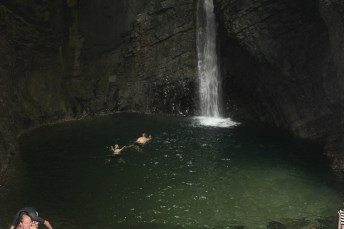
Slovenia was also the site of a mammoth hike that we are pleased to say we survived.  Up and down mountains, then up and down again, across a suspension bridge and along a cliff that ended at a waterfall and a bone chilling swim by Felice and Luke while we clung to the side of the mountain, hoping and praying they made it back to us safely, since we didn’t know where we were, where we were going, where the car keys were, where our next meal was coming from…you get our drift.

There we (Felice and Luke) are swimming to the waterfall - our skin tingled from the cold for ages after getting out
There we (Felice and Luke) are swimming to the waterfall – our skin tingled from the cold for ages after getting out
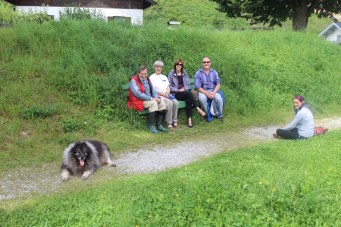
With Manfred, Huberta, and Cato the mountain dog (we still aren't convinced he's not just a ball of fluff and positive energy)
With Manfred, Huberta, and Cato the mountain dog (we still aren’t convinced he’s not just a ball of fluff and positive energy)

In Austria we visited Manfred, Huberta and Fritz Barthel, as well as Fritz’s children.  These wonderful people hosted Matt, Tim’s brother, when he was an exchange student 40 years ago.  There are not enough words to describe the love and kindness they showered on us.  We took gorgeous walks through the town, marveled at the mountains they had climbed, and enjoyed our time with them so much.  Tim, who had visited 40 years ago, threatened to never leave, now that Fritz’s daughter runs a coffee shop downstairs at the family home.

Touristing around Budapest

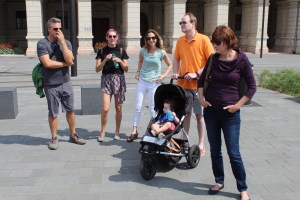
In Budapest we stayed with our daughter Eve’s college roommate, Julia, her husband Bill, and their adorable baby, Henry.  They were also wonderful hosts who gave us a great tour of the city and told us so many stories about the amazing history of Budapest.  If Tim, Carol and Luke hadn’t got stuck in their elevator it would have been a perfect visit!  (It was a small blip that, while horrifying Julia and Bill, was quite funny after the fact.)

We now have a new respect for Felice and Luke for another reason – writing blog posts is REALLY hard!  Just like every other aspect of their big adventure, they make it look easier than it actually is.

We are so thrilled to have been Felice and Luke’s first guests, it was a joy to watch them explore.  We love you so much and are so incredibly proud of you!  Live your dreams!

*Photos taken by all of us and “curated” by Felice

Zagreb, Croatia

Slovenia: Celje, Lake Bled and Bovecs

Salzburg, Austria

Bad Haring, Austria

Vienna, Austria

Budapest, Hungary 

Thoughts and feelings in the Balkans (and beyond)

For my newest excuse explaining the long duration between posts, I would like to offer: blame my parents. We have just had an extremely fun two weeks with them romping through Slovenia, Croatia, Austria, and Hungary. Also our computer broke again.

I’m actually just going to tell you about our days before picking up Mom and Dad at Zagreb airport in Croatia. For their side of the story, I ask you to eagerly await a new segment on our blog: Travel companion guest post!!! This will happen in a couple of days. For now, I’ll just say that the four of us travelled well together and packed in the excellent adventures. I am also happy to report that, to my knowledge, no one in the party tried to murder anyone else. This sets a good precedent for future travel companion arrangements, including Rachel and Manny, whom we met last night at Manny’s parent’s house in Oradea, Romania.

In the days before meeting Mom and Dad in Zagreb, we had a brief taste of slightly more offbeat travel destinations – Bosnia and Herzegovina, and Serbia (preceded by Croatia, which is decidedly not offbeat). We’ve also experienced some more extraordinary hospitality, this time from the much too sweet Rads, Leah, Peter, and Zorica in Novi Sad, Serbia.  To disentangle my confusing timeline, remember to check out the “Keeping up with the Shingle to Boggians” link, which has a list of our whereabouts.

I probably shouldn't have taken a picture of this? But so exciting!
I probably shouldn’t have taken a picture of this? But so exciting!

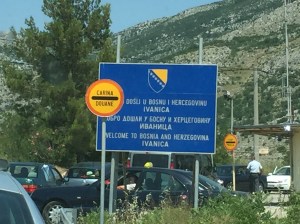
The border from Croatia to Bosnia was the first that I was nervous about (though not as much as, say, Kazakhstan to Russia, or China to Laos). I am happy to report, however, that this border crossing was – without sarcasm – simply a delight. We waited for about 20 minutes in a line on a lovely country road with a view over a valley. We did have to buy border insurance for about 30 euros (we knew we would), but the border guards were hilarious. One of them kept telling us that next time we come, we must bring them boomerangs. Travelling on an Aussie passport is fun.

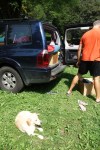
Our companion at the border. There's a person in the middle of that hay. He cut off a couple of cars and cut in line.
Our companion at the border. There’s a person in the middle of that hay. He cut off a couple of cars and cut in line, a group of pedestrians cheering and laughing.

In general, borders in this area are crazy easy. I actually mean crazy. At a couple of borders they’ve barely even looked at our faces to check we match the passports, let along looking at our car rego, insurance, or any cargo we might be carrying. I really thought borders would be stricter given the current refugee situation.

How pretty is Bosnia though?

Bosnia has beautiful nature and beautiful people. It’s very mountainous, with lots of forests and national parks. We couldn’t find anywhere online in advance to stay, but luckily we saw a sign for camping in an old national park complex. There were quite a few other people camping too. We did have to engage some 4WD action to get into the grassy area, which was fun (a Serbian/German couple joined us in this adventure with their little car). We “checked in” at the Soviet-looking hotel up the hill. This took us past a set of old tourist buildings that had clearly been shot at, shelled, and abandoned. It’s such a shame – if that complex was in Croatia it would be newly renovated and swarming with tourists.

It was a noteworthy night at that campground. First of all, there was a thunder storm. This forced us to take our glasses of wine and our activities (listening to Phantom of the Opera for Luke, and reading for me) into bed while we waited it out. I am afraid of thunder, so it was lucky that Hogwarts was there to welcome me home.

Secondly, a pack of 20-something guys spent most of the night and morning singing rousing choruses of Bosnian folk tunes at the tops of their very nice voices. I know they were folk songs because I asked the guys, which they thought was weird.

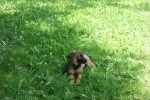
Thirdly, we got an introduction to stray dogs in the Balkans. They were adorable, sweet, well-behaved, and discernible breeds. There were three wandering the campground, getting pats and food from the campers. We almost adopted the puppy, who looked like he might have been part German Shepard. We thought he might be a good wedding present for you, Kim and Doug. Who doesn’t want a tragically adorable flee-ridden Bosnian puppy delivered to them on their wedding day, right? It’s just a LITTLE bit of potential rabies.

I mentioned before that we saw a bit of physical evidence of the war in Croatia. In Bosnia, it’s a whole other league. I don’t say this to be disrespectful or sensationalistic – it’s just true. Probably about a quarter of the buildings we saw in most places (given our very limited time there) had evidence of bullet holes, some were clearly shelled, many were abandoned (probably because people were killed, or fled and didn’t return). There were a couple of places we drove through where an entire street was thickly peppered with bullet holes. We also drove through a few towns – Foca and Visegrad, specifically, about whose history we  read. Very bad things happened in these places. It is not my history to tell, and I can’t begin to understand the complexities of the way that this recent history is recounted by the various groups of people involved. But I doubt that any would disagree that very bad things happened.

All that said, Bosnia (and also Serbia) are the places that Luke and I are most likely to travel to again – above Spain, Italy, France, the Netherlands. They are truly beautiful, they are not overrun with tourists, and the people really are incredibly friendly. We can talk all we want about the hospitality of people in other parts of Europe, but I think locals are just more welcoming in places that do not see packs of visitors all the time. In the case of Bosnia, I think people are happy we have come. Luke got his hair cut in a square in the small town of Trebinje, near the border with southern Croatia. The hairdresser was very sweet and talked to us a lot. She did, however, ask if we were “scared to come to Bosnia.” She said we had nothing to fear, it was safe. I totally agree with her. I would recommend Bosnia to any traveller with a healthy sense of adventure. Plus, it doesn’t hurt that it’s very cheap for people with AUD and USD.

A lovely market in Trebinje

Another huge bonus of Bosnia (and also Serbia) is the booze. Oh, the best booze. We bought some homemade wine in plastic Coca-Cola bottles from some ladies in a market. It was fabulous, much better than a cheap Aussie red. Also, the market ladies are great. Welcoming and informative, and quick to offer a taste of their own wine in a small plastic cup, but they don’t push.

Going into Serbia from Bosnia and Herzegovina was like driving from Detroit into Canada. Material signs of war and poverty vanished instantly in Serbia, though we did get some very small glimpses later. I’m not going to make any speculations or judgements on why this might be the case – I certainly don’t understand this situation well enough.

Our fancy-pants place in Serbia

I will make a judgement about the hotel we stayed in, located in a ski resort area in Serbia. It was MAGICAL. There were ceilings that were AT LEAST 8 feet high, and we didn’t have to bring our own toilet paper. And the wi-fi worked. We ran around in circles like idiots and jumped on the bed when we got in our room. We hadn’t stayed in a building for about a month. (Don’t get me wrong – we adore our little “house”. We’re just very easily pleased now.)

But things got even better when we got to Novi Sad. Rads and Peter work with Luke in Sydney, and they happened to be in Serbia at just the right time, with their wives, Leah and Zorica. Peter and Zorica are Serbian and they come back here frequently. They have a gorgeous house which feels like a little slice of Australian housing (the good kind) in Serbia, it was like being home. Actually, it was way nicer than the house we lived in in Sydney. I don’t think they would ever let chickens inside their house.

Touristing together
Touristing together

Anyway, our main takeaway was a feeling of being very taken care of (more delicious food and drink than we can handle, Zorica washing and folding our laundry, and sleeping in a big huge bed in a bedroom with a view of Novi Sad and the Danube). We left feeling pampered and well-rested, but also educated. Like if you went to a day spa situated in a library, but with home cooked meals.

The education bit: the fam took us on some really good tourist expeditions, for a start. We checked out some ancient Roman ruins and a couple of great historical museums in a town called Sremska Mitrovica. It was a capital of the Roman Empire during the Tetrarchy! It was such a treat to see history in a not overly-touristed place: in both museum buildings, museum staff led us around the exhibitions, explaining and answering questions.

Also, we were allowed *very* close contact with Mammoth bones.

Secondly, we had some really good chats, including with their neighbour, who popped by for a drink. He, from what we understand, is a meteorology professor at a university in Novi Sad. He and Peter were not at all shy about telling us about the history of Serbia/Yugoslavia, including the World Wars. We actually really appreciate people taking the time (and emotional energy) to tell us about their home, especially when it’s had as much history happen as Serbia has.

Rewind: Dubrovnik

Welcome to King's Landing!
Welcome to King’s Landing!

Just to throw you for a temporal loop, I’ll now tell you a little bit about Dubrovnik, which we visited prior to Bosnia and Novi Sad. The first, but least important, tidbit to note about Dubrovnik is that it is the filming location for all the King’s Landing scenes in Game of Thrones. Luke and I did geek out about that a little, yes. But more importantly, Dubrovnik is a beautiful ancient town. It’s insanely touristed – the throngs were still descended when we arrived by boat at 9pm for a walk around. However, it is one place we would recommend despite the hordes. There’s also very important recent history, having been under siege for several months in the 90’s.

Until next time!

Southern Croatia and Dubrovnik


Bosnia

Serbia

Lots of cucumbers in Croatia (plus Italy and Slovenia)

We apologise for the long space since our last post. We thought our computer was broken. Luke sat on it, and it now looks like a banana (J/k, but it is bent). It wouldn’t turn on, so we couldn’t use it for several days. We took it into a computer repair shop in Zadar, Croatia, where we pressed the “on” button and it turned on and worked. We thanked the computer man for “fixing” the computer (he said it was the “positivity” in the shop), and now I can write the blog.

This was not the first time we have looked like idiots in Croatia. We realized one day that we had not seen one of our credit cards in a couple days (horrible sinking feeling, right?). We traced back our steps to a petrol station we had stopped at two days before. We drove 20 minutes back to it. The moment we entered, the fellow at the front counter threw his hands in the air and dove into a drawer under his front counter, retrieving our card. We had left it in the freaking card machine. (I say “we” so as not to implicate any individuals in this mistake.) This fellow was so relieved to see us. He said he had called after us, whistling. He had called his friend at the next petrol station down the road, who came out to the street and flagged us down with waving arms. (Clearly we did not see him.) He even called the frickin police, and told them to stop any blue Mitsubishi Shoguns they saw. Clearly they didn’t. We like to laugh at what we would have done if the Croatian police had pulled us over, said something about a credit card, and made us follow them 20 minutes back down the road. We would have found the first available hiding space in the forest. Anyway, hooray for this super upstanding and law-abiding Croatian petrol station worker.

Croatia is insanely overrun with tourists in most places. Example: Plitvice Lakes National Park. Just look at the photos, it is actually the prettiest place in the history of ever. What I didn’t take pictures of was the tourists, clogging the paths and stopping abruptly for photos (like the ones here on this blog). Luke and I were weaving through the hordes, jumping over puddles and squeezing through tight spaces between tourists, because we like to MOVE IT MOVE IT. There was a duo of young French guys who we enjoyed competing with to see who could dodge other tourists the fastest. At one point one of them yelled “WE DID IT!!” after passing a particularly sluggish group. Of course, as you’ll see from the photos, it was well worth the tourist-dodging.

I mean, just look at it. Would you dodge tourists for this?

As much as our last blog post showed contrasts in the natural settings we visited, this blog post shows incredible contrast in the touristiness of the places we’ve visited. Examples:

10/10 on the touristy scale: Pompeii

Very well preserved paintings in someone's house in Herculaneum.
Very well preserved paintings in someone’s house in Herculaneum.

I have been to Pompeii twice before this, and I was thrilled to go back. Luke was unsure. Because I was aware that Pompeii itself would be heaving with our fellow sight-seers, I decided to start with Herculaneum, a smaller town about 20 km away from Pompeii. Herculaneum was destroyed more quickly than Pompeii. The culprit was the pyroclastic flow – hot and dry ash, gasses, and bits of rock. It’s actually way better preserved because of how it was covered. There is an intact 2nd floor wooden balcony over a street, for example. And – bonus – way, way, way fewer visitors. All the photos we have are from Herculaneum.

DSC01656
The setting of my historical fiction daydreams.

We did also go to Pompeii, which I loved despite the 10 bajillion people. I listened to ALL OF THE THINGS on the audioguide, including the extra information sections not attached to sites. Did you know that they washed clothes in a process involving urine and clay? I was an annoying student in grade school, yes. However, one thing to note about Pompeii, if you haven’t been there, is that it is a full city. There are busy streets (like the one with the brothel, of course), and there are empty streets where you can just go into empty restaurants and pretend you are a Roman craftsperson taking a break from your day of doing mosaics in the atrium of a house belonging to a local person of prominence, while in a country not far away the apostle Paul was writing some of his letters. That’s what I did.

0/10 on the touristy scale: Salvatore’s place

We did a lot of extra driving to get down to Pompeii, and we had to stop somewhere easy over night on the way to Venice. We found, on google maps, a campground in the countryside in Campania. When we pulled up past a small farm into the campground, it was seemingly empty. A young guy (19, it turns out) came out to meet our car. He said we could camp, and asked where we were from. When we said Australia/America, he got so excited. “WOW! WOW! AUSTRALIA!”. After paying for the night and talking about us having Kangaroos as indoor pets (jokes), Luke went to the car to get him one of the Australia-themed tea towels we brought. He, in turn, held the tea towel with two hands as if he was holding a gold medal from the Olympics, he seemed blown away. What a nice guy.

We got to talking with him. Through some sort of language-related misunderstanding, he thought, at one point, that I had asked to see his horse. He cheerfully said, “OK! 5 minutes!” and ran away. 5 minutes, here comes Salvatore and horse Marta up to our car. We gave her a pat – calmest, sweetest horse ever.

Next, after we started discussing chickens, he asks if we want to go to his Grandma’s house to meet her and the animals. Um, YES!!! So over we go, down the country lane, to Grandma’s house, who is a delightful old Italian lady. Uncle is there too. They take us around the house, introducing us to:

IMG_7393
Om nom nom nom
  • the chickens: there are dozens, roaming free around the farm, eating fresh wheat grains harvested meters away
  • the free-range pig: Uncle throws a melon from a wheelbarrow to the sow. She shows off her powerful jaws by splitting it open in one bite and chomps blissfully.
  • the kitten: Grandma disappears around the corner of the house and comes back with a tiny kitten, whose eyes had just opened, and handing it to Luke for a cuddle.

Before we left, we bought a few eggs from them, and they gave us some cucumbers growing by the side of the house. We kissed Grandma and said goodbye, obviously gushing about how we love this place SO MUCH.

IMG_7401Later, as we were munching on our delicious cucumbers at our campsite (just olive oil and salt, as Uncle said), who walked up, but Salvatore and Grandma. She’s brought more cucumbers for us. She grasped my face with both hands and told us we are beautiful. She came back the next morning too, with our final batch of cucumbers, to say goodbye. We ate every one of those cucumbers.

A meal comprised entirely of gifts from benevolent strangers

At this same campground, there was a couple who were setting up for a group of scouts to arrive the next day. They were staying in a cabin not far from our site. We said hello to them, and they smiled. They didn’t have any English, I don’t think. But they brought us dinner! Out of nowhere, the guy just walked over with a plate of spaghetti with fresh tomatoes, smiled, and left. No word. It was the best pasta we had in Italy, too.

Honourable mention: Pitigliano

A farmstay in Tuscany. When we asked the owner for wine, he gave us a jug from the cask.

I should also give an honourable mention in the non-touristy category to our farmstay near Pitigliano, in Tuscany. We were the only campers here, too. Upon arrival, the owner took us inside and made us 20 minutes of photo montages of the local area on his TV, while explaining the history and sites to us in Italian, broken French, and a few words of English. His pride was justified. Look at the pictures of Pitiliagno (AKA Little Jerusalem) and the nearby natural, public hot springs. I’ll save the descriptions for the captions. Suffice to say, it’s spectacular and it’s locals only. Cheers to a Florentine fellow at a campground in France who told us to go there.

Somewhere in the middle: The Sea Organ

Luke enjoys the seaside next to the Sea Organ

This is a neat thing. In Zadar, a coastal city in northern Croatia, there is a thing called the Sea Organ. It’s stairs, which lead into the crystal clear Adriatic at the foot of the town. There are holes in the stairs, and pipes underneath. The waves pump through the pipes, creating ethereal, ever-changing music. Locals jump off the stairs into the water and dangle their feet in the waves, while a few tourists sit and listen. It’s beautiful.

And just a really good place: Slovenia

Slovenia was a hit. We only spent two nights, sadly, but we’ll be going back with my parents in a week or so. The campground was the first that was so fabulous, it inspired me to write a TripAdvisor review (Dujcevi Domaciji). For the first time on this trip, we got to have a fire, which was excellent in and of itself. Not to mention the Slovenian (read: potato-based) meal cooked up by the owner’s mother for dinner.

Luke in his element. Alcohol, fire, and a sharp axe. (This has ever disturbed me before, until I wrote caption)
Luke in his element. Wine, large fire, and a sharp axe. (This has ever disturbed me before, until I wrote caption)

Skocjan Caves: If you are ever in Slovenia, go there. If you would like to see a real-life Balrog habitat, go there. If you are terrified of heights and/or not seeing the sunlight, don’t go there. It’s an underground river, which includes an underground bridge perched 60 metres above the river. No photos are allowed inside, so if you’re curious you’ll just have to look on the internets.

A final word: Yugoslavia’s war

Because I love to end things on a depressing note, let’s talk about war. Not long after crossing the surprisingly easy Croatian border, we drove through a small town with a bit of a town hall in the middle. It was boarded up, with roof collapsed in and the walls completed riddled on 3 sides with bullet holes. I didn’t take pictures because something inside me says that might not be respectful.

We read a short history of each country we enter as we drive. We have had to read about the Yugoslavian war, about which we knew shamefully little. (Despite my social justice-conscious mother giving me a book about a girl trapped in Sarajevo under siege – Zlata’s Diary, it’s fantastic). I just remember joining in on joking around “with” two kids in my high school, one Bosnian and one Serbian, about their hatred for each other. I realise now there were probably no jokes there at all.

It’s odd to think, as we float on our backs in the salty Adriatic surrounded by European kids jumping around on plastic inflatables, that this country was immersed in a war only a couple of decades ago. I’m guessing I’ll have more to say on this as we enter Bosnia and Hercegovina, Serbia, and the Eastern parts of Croatia and Slovenia in the coming days.

Until next time!

Florence and Siena

Country Tuscany: Pitigliano and surrounds

Herculaneum, Vesuvius, and Salvatore’s place (WARNING: Real skeletons)

Venice

Slovenia and Croatia

Lamborghinis and jumping off rocks: Southern France, Monaco, and Italy

Cinque Terre is a group of five villages without car access that were built on the side of mountains rising above the Mediterranean. This one is Manerola.

It’s been a few days of contrast for us since our last post. From the flat French mediterranean coast, up into the mountains, down into the Gorge du Verdon that cuts through said mountains, and then down to Monaco, along the French coast to Genoa, where we camped in the hills amongst redwoods. We spent last night and today traversing the Italian coastal towns of the Cinque Terre, and their accompanying vineyards terraced high above the sea. We moved onto a campsite outside of Florence, which also happens to have a section of cabins that belongs to the Contiki tour company. There are three bus-loads worth of pre-drunk 18-35 year old Australians swarming the place, but luckily the campsite owner told us where to park so that we can’t see or hear them, and it works. We did a half-hearted tour of Florence (it was hot and we were tired), and now we’re sitting by the campground pool in Siena.

Adventure Sports Time

I don’t consider myself a particularly brave person when it comes to heights, so when I jumped off of a 6 meter (18 foot) rock into shallow water not once, but twice, I admit that I was quite chuffed with myself. It was peer pressure that made me do it. Backing up, the Gorge du Verdon in southern France is a spectacular, you guessed it, gorge that is up to a kilometre (800 feet) deep at some points. It’s crowning feature is the Verdon, which is a magical green/blue river that runs down the middle. Luke and I decided to explore it in two ways: By hiking and canyoning.

Look at the very bottom - there's some water there! We hiked down to that from where this picture was taken.
Look at the very bottom – there’s some water there! We hiked down to that.

For the hike, we started at the top of the gorge, walked down to the river, and back up again, an elevation change of 460 metres each way. We cheerfully joked as we descended that it was really going to hurt on the way back up. It did. I would like to brag that Luke ran the last 20 minutes up, just for some extra fitness. I went slower and tried to have conversations with the lime-green butterflies (they said to say hi.) But the gorge at the bottom was well worth it. See photographic evidence below.

As for the canyoning: for those of you who haven’t previously been annoyed by our repetitive canyoning stories (we’ve done it twice before), canyoning is basically just walking down the middle of a river/stream that’s in a canyon. It involves jumping off rocks, sliding down waterfalls, swimming, some abseiling, and general silliness. We wanted to canyon down the main Verdon gorge, but unfortunately the power company upstream had let water out the dam off schedule, flooding the river dangerously. Instead, we canyoned down an equally beautiful tributary. There’s no photographic evidence of this journey, sadly, but suffice to say the canyon was made of lily white rocks (limestone!) and crystal clear blue/green water.

This is the Gorge du Verdon. But this is what it looked like where we canyoned.

We took to the canyon with 8 friendly French people, including our guide. We found friends in the most adorable teenage sisters, who giggled when they saw Luke braiding my hair, and then insisted on helping me get my wetsuit on. They took it upon themselves to translate everything for us (“Log underneath here!” “Jump to the left, there’s a rock to the right!” “Careful, slippery!” “Only small people through this waterfall running through the slit in the rock and under some boulders, Luke must climb over and jump!”) When we got to the 6 metre jump, I thought about chickening out. I did it, though (as did Luke of course). It feels like you’ll never hit the water. Just as I thought I was done, triumphantly swimming towards the clapping group, the adorable sisters called my name to clamber up the rocks with them and do it again. I was peer pressured. I did it again. (To be fair, it was really fun.)

Finding ourselves

Luke didn’t do the stereotypical “finding yourself” European backpacking trip in his 20’s like I did, so we joke that he’s doing it now. We’ve decided he is on a real, bonafide journey of personal exploration now that’s he’s wearing Moroccan linen (he bought it in Granada.) A person can’t find themselves without earth-tone linen tunics.

As for me, I “found myself” when I saw my heritage reflected in a fun conversation with a bunch of Italian rock climbers at a campground in La Palud sur Verdon (a small and non-touristy town in the Gorge du Verdon area). I got into a discussion with them because the woman had bright fuchsia hair. Turns out she’s a hairdresser from Bologne and, fun fact, married her husband (also present) at an Elvis chapel in Las Vegas that is now a supermarket. Anyway, they group got into a discussion about where we should go in Italy. Things got dramatic when they started to discuss wine. It was all in Italian, but I could understand them shouting, “Chianti!” “Multepulciano!” “No, Chianti!!” “No, no, no, Multepulciano!!!” while waving their arms in the air and tsking loudly. This sort of thing happened frequently in our lengthy conversation.

Other fun characters we have met along the way include a befuddled-looking Czech walker who I first met when he absentmindedly wandered into our campground, his phone dead and having taken a wrong turn. I helped him find his way (he promptly went the opposite way of what we had decided), only to run into him again two days later in a mountain village about 80 kilometres away. He said he reached it on foot. I expect to see him somewhere in Kyrgyzstan or Laos, having lost his socks or gotten stuck in a telephone booth.

Pretending to be James Bond

This is a 60 foot speed boat called "Gush". It had a custom floormat on the dock that said "Gush."
This is a 60 foot speed boat called “Gush”. It had a custom floormat on the dock that said “Gush.”

We did a big driving day to get from the Gorge to Genoa, Italy. It was our most diverse and probably most beautiful day of driving. We decided on a whim to pop into Monaco, as we were driving fairly close by anyway. For today’s geography lesson, we’ll learn that Monaco is

What Luke pretended he was driving

the second smallest nation in the world (after the Vatican), it is not part of the EU (but uses the Euro and doesn’t have border checks), and has enough Lamborginis and Ferraris to make the BMWs, Audis, and Porches pedestrian and unexciting. It seriously lived up to its glam hype. We didn’t eat anything or spend the night, but I could feel the money being sucked out of my pores when we passed the Monte Carlo, the famous casino that seems to cover half the country. Luke enjoyed driving on the twisty roads, pretending he was James Bond and our car was something other than a dusty Pajero with a bag of stinky laundry in the back.

Also, the drive from Monaco to Genoa, along the French Riviera: I totally get why it’s a toll road. It’s either tunnel or dizzyingly high bridge, without any normal road, for about 100 kilometres. It passes over a valley, barrels straight into the next mountain, and pops out over another deep valley. I’m happy to pay my €8,70 if it means that bridge doesn’t send me flying into the ritzy village below. Also, there are a lot of terraced greenhouses. We have learned that they grow a lot of basil, which goes into Genovese pesto, which we are binge eating.

On a bridge, headed towards a tunnel

More about driving

An Italian stereotype we were aware of prior to entering Italy was that the drivers are insane. So far, our experience has only confirmed this. According to Luke, there are two types of Italian drivers: ones that do double the speed limit, and ones that drive at half the speed limit, swerving erratically, talking to passengers or on their cell phones, gesticulating wildly with both hands (“like they are tossing a salad”, Luke says).

Shhh, they don’t want you to know about this

In closing, I would like to let you in on a conspiracy. Some devious mastermind, for unknown reasons, has been teaching all Europeans to say “funny” when they mean “fun”. Seriously, even people with otherwise 100% flawless English. We don’t yet know the goal of this widespread and mysterious conspiracy, but I’m sure it has something to do with world domination.

Maybe The Brain is behind it! Though it does sound more like a Pinky idea. (A van in Florence)
Maybe The Brain is behind it! Though it does sound more like a Pinky idea. (A camper van in Florence)

Entering France, and the Gorge du Verdon (including the villages of Moustiers-Sainte-Marie, Annot, and Entreveaux)

Monaco and the drive to Genoa

Italy: Genoa and Cinque Terre

Goodbye to Spain

Friendly reminder: We suggest that you click on the title of this post to read it on the website, rather than reading it in your email.

It’s a positive news day: we now have our Russian visas! We popped by Madrid a few days ago to pick them up at the visa office, at the exact date and hour they specified, of course. This means that I can now tell the visa story without jinxing things (though I suppose we still have to actually be let into the country – twice – which is not a given).

But first, some more contemporary updates. We have now officially ended the Spanish leg of our journey, as we crossed the border back into France yesterday afternoon. We’re now staying on the beach (again) near the Spanish border, and we’ll be spending the next week travelling across southern France.

Literally off the beaten track in Costa del Sol

IMG_6018
This is after the killer chihuahua almost got us.

We were warned not to go to Costa del Sol, which you’ve already heard me talk about a little (I wrote our last blog from there.) We were told it was a soulless, non-Spanish wasteland whose formal coastal beauty had been demolished to make way for high-rise apartment blocks to house Brits.  Largely, we found this to be true, though we just couldn’t find it in our hearts to hate it. Whatever, if people want to hide away in dodgily built condos and eat fish and chips all summer, that’s their business. We did, however, try to avoid it. So, when we required groceries, we were not too excited to leave our campground oasis to go into town to get some. 

We decided a bicycle ride would make the trip tolerable or even pleasant. We were told to go to out to the main road, cross it, and immediately turn right. We thought we did this. We did not. We cycled happily for ages (the shops were only supposed to be a couple kilometres away), on a dirt track, through banana groves and fields of recently cut sugar cane. We started to wonder where we were. Litter was strewn across the path and chain link fences guarded the few derelict properties we saw. A dog started barking menacingly, and my life flashed before my eyes. (Shut up, I’m dramatic, leave me alone.) It turned out to be a chihuahua, but there were others we could not see, so I’m sure my fear was totes justified. Also, a horse followed me along the path for a while, on the other side of its fence, which was friendly. We finally decided we were absolutely not headed towards the market, and veered off the path. And before you accuse me of being an irritating millennial who insists on misusing “literally”, as in the title above: we ended up on a track through a banana field that was not actually a track, but a bit of an irrigation ditch/trash collection point. We had to get off of our bikes and semi-run to avoid being eaten by the pack of rabid dogs in my head that were just trying to protect their property. Anyway, we eventually made it to the store and bought beans and carrots. The end.

Valor 

A scenic walk to town

Perhaps the lovely Nick and Louise invited us to visit them in southern Spain before they realised that we would be overstaying our welcome in Louth by at least thirteen days. Perhaps they are masochists, or maybe just love the thrill of a risk. Whatever the case may be, they welcomed us into their lovely holiday accommodation in the Sierra Nevadas for a night, and, no less, on their 15th wedding anniversary. This is fitting, I think, because my family and I also went on their honeymoon, so infringing on their personal moments seems to be our schtik. Anyhow,

See? Free delicious sparkling water!

we had a fun and pee-inducingly hilarious reunion in the small white village perched precariously on a hillside, a world away from the grossness of the coastal high rises. This village – Valor – can only be reached by terrifying mountain passes (more later), has the most fabulous little tapas bars, and, to top it off, has beautiful sparkling water just pouring out of a spigot down the hill from Nick and Louise’s house. It’s seriously fizzy like Perrier but far more delicious, and you just fill all of your bottles with it. Magic.s

During this visit, Luke was hanging out the laundry and decided to see what it would feel like to repeatedly brush up against a big ol’ cactus, because he’s a guy who’s open to new experiences. It was VERY FUN for me to pull the pricklies out of his arm with tweezers, once he realized his painful mistake. I even got to use duct tape to peel out the little suckers. So satisfying. Nick and Louise were disturbed by my joy.

SO FUN.
SO FUN.

But about those roads: I thought the Pyrenees road was scary. This one, this one. In places, it was one lane, with traffic going both ways. There was no shoulder- the road fell straight off an inch outside of the line, down a cliff on one side and into a huge ditch on the other. On the switchbacks, there were signs to honk your horn to tell invisible oncoming cars to slow down. This was not fun for me, but we were lucky. We saw few cars, and those that we did see were going slow, and happened to appear on segments wide enough to slip past each other. We live to tell the tale.

The beauty of Islam

This says: "There is no conqueror but God." Carved into plaster.
This says: “There is no conqueror but God.” Carved into plaster.

Some of our dear readers may be aware that I’m a bit of a fangirl of Islamic architecture. The tile mosaics that are symmetrical on up to 8 axis, praising the perfection of God. The ornate plaster carvings with beautiful Arabic poetry. The white buildings that seem to float in air, the gardens that are a delight to the senses – smell, sound, touch, sight, and taste. Nowhere in the Western world is this stuff demonstrated better than the Alhambra (at least to my limited knowledge). The Alhambra, nestled in Granada, southern Spain, is a royal city that’s been constructed, added to, demolished, re-constructed, constructed differently, forgotten about, restored, and so forth for at least 1,000 years. It’s got palaces, theatres, churches, fortifications, houses, baths, monuments, and hordes of overheated American tourists. This particular overheated American tourist took ten million pictures and has included them below. I’ll skip the history lesson this time, but I will direct enquiring minds to the wikipedia article.

Who else is singing this in their head: He sees angels in the architecture, spinning to infinity, and he says, 'hey, hallelujah'
Who else is singing this in their head? “He sees angels in the architecture, spinning to infinity, and he says, ‘hey, hallelujah'”

The beauty of Catholicism

I saw La Sagrada Familia while travelling with my friend Mikaela over 10 years ago. We didn’t go inside, maybe because we were poor student types or maybe disorganised or maybe lazy? In any case, I was prepared to be blown away again by the outside of this church in Barcelona. It was designed by Gaudi, the Spanish architect famous for being the most austere Christian guy producing the most wacky of buildings. It’s been under construction for about a century and is still a long way off from completion – at least another 10 years – but it is already mind-boggling. It’s got completely different architecture on the outside for the stages of Christ’s life, especially contrasting for his birth (organic shapes, animals, plants, realistic people) and his crucification (hard, scary lines and almost cubist people).

The exterior side of the church that depicts the crucification. Look at Jesus. Also, note that the soldiers are wearing scary storm trooper helmets.
The side depicting the birth of Christ. It looks like it's old or melting, but it's not - it's all intentional.
The side depicting the birth of Christ. It looks like it’s old or melting, but it’s not – it’s all intentional.


But the inside I was not prepared for. The light and the feeling are totally unlike any other church I’ve been in, and I’ve been in a few. It made me cry a little. Also, it made the goth couple at the entrance make out really intensely while blocking everyone’s paths into the church. Actually I won’t do any guesswork as to the inspiration for their extreme version of PDA, but it was definitely inappropriate (maybe their goal?). In any case, I won’t try to describe the church, I’ll leave it to the photos below.

Silly Gaudi! (In Parc Guell)

Gaudi’s architecture is dotted throughout Barcelona. He has about 16 works in the city, ranging from sets of lampposts, to a failed housing estate-turned-public park (Parc Guell), to La Sagrada Familia. We did a very long touristing day, all on foot, to an apartment complex, office building, La Sagrada Familia, and Parc Guell. Luke was extremely impressed with Gaudi, which was a relief for me, having planned a whole day of the architect. He loved how the buildings lead your eye from one place to the next, and lack reference points as we normally know them (corners, sharp edges, defined points of view, etc.). Every element – down to individual columns or windows – is unique, and are often arranged asymmetrically. He also commented that Gaudi is one of the only architects he’s seen who produces not only beautiful, but highly practical and excellent feeling spaces. The architecture works with light and air beautifully, it’s very holistic. I’m sure Gaudi would be happy to know he has Luke’s approval.

OK, finally the Russian visa story.

In order to help you properly understand our pain in this situation, I require that each of you, prior to reading further, must list, in the comments, places and dates for everywhere you’ve been in the last 10 years, the full names of your parents, any organisations you’ve ever been affiliated with, the technical specifications of the cars you own and the names and contact numbers of every boss you’ve had.

We actually had to tell Russia all of this. We spent a day preparing the information. We went to the visa centre, me with my overachieving student posture fully deployed (back straight, chin up, neatly organised folder of paperwork clasped in my arms, judging gaze towards others who look less prepared). It did not go as expected, because I did not understand Russia. I’ll do this in bullet form:

  • Wait. Reach the desk, only to be told by the frenetic Russian gatekeeper, in Spanish, repeatedly, that it was 100% impossible to get a visa in Madrid, or Spain, or anywhere in Europe, in all cases, because we are Australian. There was absolutely no way, ever, to get a visa, other than actually flying to Sydney. So I cried. She called the embassy, and voila, she was telling us to take a number and sit down.
  • Wait. Reach the paperwork-taking desk, where we were told we had the wrong visa invitation. There was no way they would accept it, lo siento. Of course, we were supposed to have read the Russian letter and seen that it said “tourism” rather than the required “auto tourism.” We retreated to the car park, where we arranged for a new invitation online. Wait.
  • Wait. Arrive at desk again, where we were told the car paperwork was all wrong, all wrong, there is no way they could accept it. Go gather this long list of paperwork, lo siento, we cannot accept this. We retreat to gather the paperwork.
  • Come the next day, wait. When the frenetic front desk lady sees us, she tells us we must leave. Turn around. They are closed, no longer seeing customers. Today is Friday, she tells us to return Tuesday, maybe Wednesday. Lo siento, she is sorry, we must leave, no choice, goodbye. I cried. This is where our English-speaking angel stepped in to translate for us, and we were told to sit down and wait. We waited there until after closing, until they called us to the front desk. They looked at our paperwork briefly. They handed back almost all of it to us, without recording any information or taking copies. They took an enormous chunk of money out of our bank account and told us they would submit the visa to the embassy, no promises. We left, our spirits broken despite our half-hearted victory.
  • Despite all this, I’m still quite excited to go to Russia.

That’s all for now, folks. We love you all!

Granada (including the Alhambra)

Valor and the Spanish countryside in/near the Sierra Nevada mountains

In and around Barcelona

Into southern Spain – three cheers for t-shirt weather!

We are thrilled to now be down in Andalucia, southern Spain, where the air is warm. We have stowed our jackets in the slightly-less-accessible hatch under our drawers, and have been sleeping with the windows down and the sunroof open. Luke has even fitted some very profesh mosquito netting so that we don’t re-create the great mosquitapocolypse of three nights ago, in which we woke up every couple hours to turn on the lights and smash mosquitos. I got to hear all of Luke’s best swear words. He really disparaged the character and parentage of those poor mozzies.

IMG_5539
Lukey boy, being an adorable man child. Notice the kitty cat umbrella (he bought this) and the buried feet. On the beach in Andalucia.

At the moment, we are travelling like spoiled sun-starved Brits (Nick and Louise – this is not you). We are staying in beach campgrounds, simply hanging around, taking a dip in the ocean, sunbathing with extensive sun protection so we don’t look 80 when we’re 40 (hi mom!), and just generally not experiencing the culture of the local area at all. I do get pangs of guilt about this, but we have seen Cadiz and Cordoba, and will do some touristing yet. We just really need the rest. We’ve also enjoyed doing some exercise – Luke has unhooked the spare tire and does dead lifts, bench presses, and other manly and masculine exercises with it. I do yoga. No gender stereotypes in this relationship, no sir.

IMG_5570
Sunset beach walk. A very satisfying way to end my 30th birthday. (Actually, it ended with drinks the the campground bar, but this is more poetic.)

You can take the boy out of the farm…

But he’ll still frequently take note of agricultural practices in Western Europe. This includes, but is not limited to, comments regarding irrigation, ever changing stages of the wheat crops, size of paddocks, type of tractors, and how the hay is baled. This is adorable. Thank you to Ken and Sue for raising an adorable farm boy. I will now give some examples.

  • In Spain, oats, barley, and wheat are winter crops harvested in late spring or early summer, whereas further north (e.g. the Netherlands) they are summer crops, harvested around Autumn.
  • Further north, there are tiny amounts of livestock in big ol’ paddocks, because those animals have to survive in cramped barns and be fed hay over winter. Down here in Spain, they are out eating the (albeit sparse) vegetation all year, so there are much larder herds.
  • Irrigation – there is hardly any up north. There is some in the south, a centre pivot here or there but still not as much as in Australia. Here in Spain they sometimes have raised v-channels – like tiny baby raised aqueducts – which do flood irrigation.
  • Yes, Luke did dictate these items to me. I do not know these words.

Swarms on the beach

Our first beach campground in Southern Spain had lovely access to the beach. However, we decided to find another, even more secluded beach on which to relax. We drove 15 minutes, and clambered up and down a huge hill. We even had to duck under some bent barbed-wire fence. (Don’t worry, we found a Spanish couple who trekked with us and validated our stupidity.) We reached our beach and were indeed rewarded by an almost empty beach, not a building in site, sheltered from the wind, with beautiful silky white sand. Until a hiking group came over the ridge, at least two dozen people, then 3 dozen, 4, 5, they just kept coming. Only it wasn’t a hiking group. It was all men. All men in uniform. The f***ing Spanish Army chose our tiny quiet beach for their excursion afternoon. They set up their soccer goals and volleyball net, and proceeding to shout, run, and just generally be as loudly male as possible. The women on the beach almost immediately put on their clothes, packed up their umbrellas, and left. What’s a pleasant beach day without a horde of soldiers to keep you company?

Life in the campground part 2

In the last “life on the campground” segment, I got carried away with anecdotes and didn’t give you any actual information about what the campgrounds are like here. (I realised when talking to my mom- she has very specific questions, which I love.) The campgrounds all have the same basic convenient elements:

This campsite in Cordoba had crazy high hedges, but no back hedge. Still very comfy.
  • Reception with friendly staff who give you a map of the site and the surrounding area, if you ask
  • A building with toilet stalls (BYO toilet paper, usually – DO NOT FORGET) and showers (usually, either pay for 5 minutes or push a button to get spurts of a few seconds of water, which is maddening)
  • Usually attached to the outside of
    Still lots of room behind the car for lounging!
    Still lots of room behind the car for lounging!

    this building, a row of sinks for washing dishes, and a row of sinks for washing clothes. These are not to be mixed. One campground had a sign that said that anyone caught using the sinks for the wrong purpose would be “sanctioned.” (lost in translation? Maybe not, this is the EU.)

  • Often, a small building with a rec room with chairs, table, book swap, sometimes TV
  • A laundry room (paid, sometimes Luke has to slam the dryer with his mighty paw to get it to start. That happened once.)
  • Usually, grassy plots delineated by hedges or trees. Only a few have been just open plots of grass.
  • Usually, a few permanent dwellings, which are usually RVs/caravans that are parked in one of the plots, with maybe a porch and some planter boxes added.
  • They do not all have flamenco guitarists practicing in the plot across the path, as we do right now. It is lovely. However, this being Costa del Sol (Brit-focused mass market tourism mecca), we can also hear go-carts. And a go-cart announcer, which seems superfluous.

Warning: history lesson ahead, skip if easily bored

The outside of the Mesquita

We visited the Mesquita (mosque) in Córdoba, which is now officially called the Córdoba Cathedral. So it goes like this – the site was originally Christian (Visigoth, google it). In the 700’s it was split between Muslim and Christian halves, until in 784 the Muslim emir (king) Abd al-Rahman I bought the whole shebang, knocked it down, and built (most) of the structure we see today. However, the Christians took it over in the 1200’s when Córdoba fell in the Reconquista (which was a 700-year period of history when Christians took back Spain from the Muslims, by force). It’s now Catholic – see my photos below for bizarre evidence of this. Muslims have asked to worship there, and the Catholic Church – all the way up to the Pope – adamantly deny this. I invite each of you to have your own opinion about this situation. I am happy to supply you with an one should you be lacking.

We found flamenco in Cordoba! Really, it wasn't that hard, since our
The elusive and secret and not at all enormous concert

Also, we found Flamenco! Ok, so it wasn’t that hard – the guy working reception at our campground told us the time and location, and there was really loud pumping music and a huge stage in the main square. Anyway, Córdoba had a flamenco festival that night, running from 10:30pm to 5am. Apparently the Spaniards make up the lost sleep with siesta, as if that helps. We are old people so only saw the first concert, an incredibly virtuosic cantora (flamenco singer) named Argentina. She was nominated for a Latin Grammy last year! The Arabic (and Jewish) roots of flamenco were so easy to hear with Argentina’s style. This was very exciting for me and I generously took the time to lecture Luke about it extensively. I’m sure he was very appreciative.

As always, we love you all!

Cordoba

The south coast and Cadiz